


Imagine a rocket so enormous that watching it leave the ground feels less like witnessing a conventional launch and more like watching an entirely new era of engineering unfold.
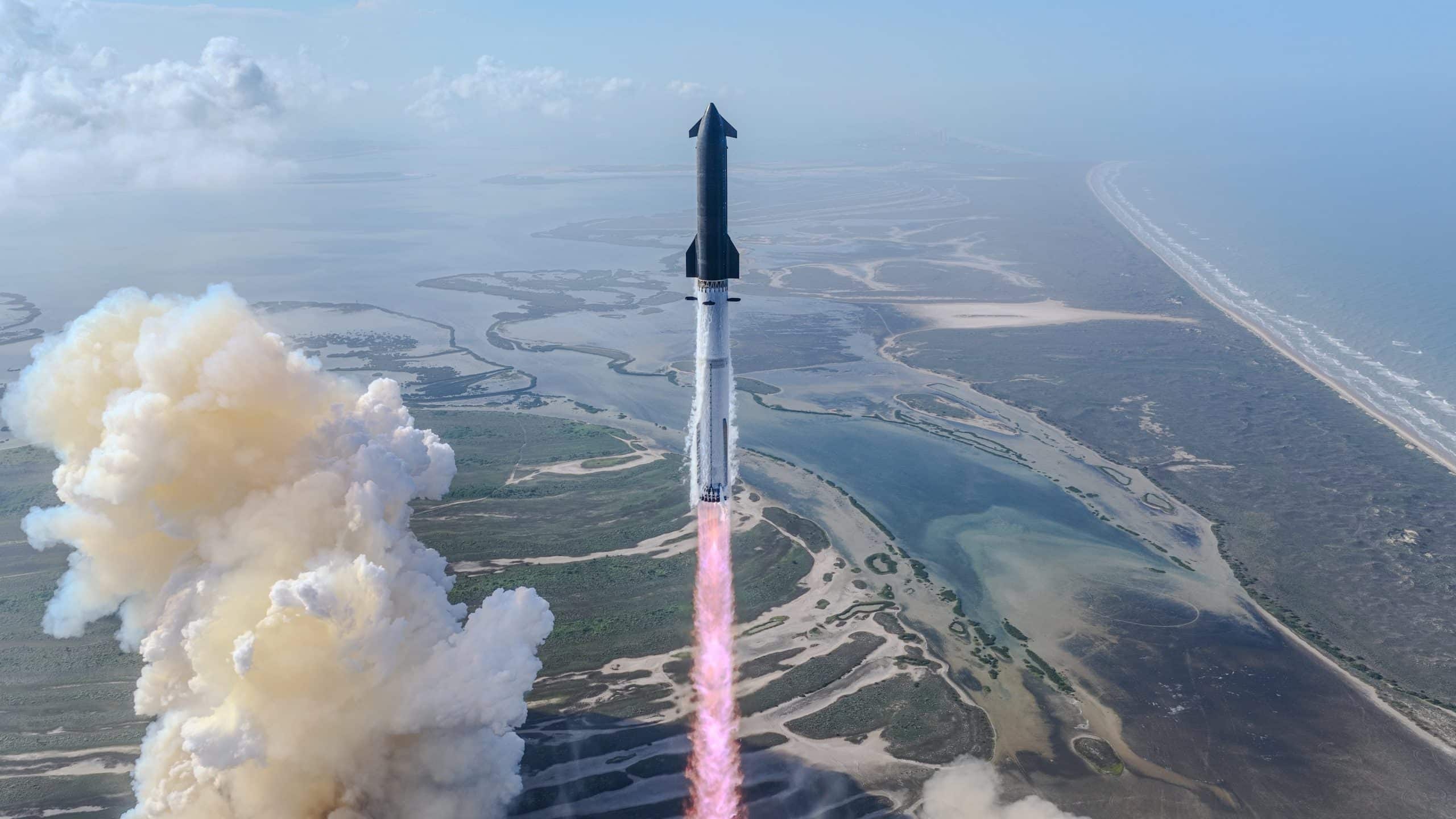
Now imagine that, instead of allowing its components to fall into the ocean after completing their mission, the company behind it wants to bring both parts back and catch them using enormous mechanical arms attached to a launch tower.
It sounds like something pulled from a futuristic film.
But this is precisely the ambition behind Elon Musk’s SpaceX Starship programme.
The company’s latest-generation Starship V3 is not simply another rocket designed to travel into space. It represents a much bigger experiment in how spacecraft could be built, launched, recovered and reused.
And with another major test approaching, the world has another reason to look towards the skies.
MEET THE MACHINE: STARSHIP V3
Standing approximately 124 metres tall when fully assembled with its Super Heavy booster, Starship is among the largest and most powerful launch systems ever developed.
It consists of two major components.
The first is the Super Heavy booster, the enormous lower section responsible for providing the initial thrust needed to lift the vehicle away from Earth.
Above it sits Starship itself, the upper-stage spacecraft designed to continue the journey beyond the atmosphere.
Together, they form a transportation system intended to carry people and cargo into Earth orbit, towards the Moon and eventually to Mars.
But what makes the latest generation particularly interesting is the engineering behind its intended reusability.
Rather than treating rockets as expensive equipment that can only be used once, SpaceX wants to recover both stages and prepare them for future missions.
The ambition is simple to describe but extraordinarily difficult to achieve: make travelling to space more like operating a reusable transport system than building a completely new vehicle for every journey.
THE CATCH THAT COULD CHANGE EVERYTHING
Perhaps the most fascinating feature of the Starship programme is not its size or appearance.
It is the landing system.
Traditional rockets often rely on landing legs, parachutes or ocean recovery procedures to bring components back to Earth.
SpaceX has been developing a different approach.
At its Starbase facility in Texas, the company has constructed enormous mechanical arms, nicknamed chopsticks, attached to a launch tower.
These arms are designed to catch returning rocket stages before they reach the ground.
The Super Heavy booster has already demonstrated successful tower catches on previous test flights.
However, catching the upper-stage Starship presents a much greater challenge.
The spacecraft travels higher and farther, and its return involves an entirely different set of flight conditions.
For the upcoming Flight 15 mission, SpaceX intends to attempt something particularly ambitious: recovering both stages at the launch site.
If successful, this would represent a major milestone in the development of fully reusable orbital launch systems.
And that is what makes this mission so interesting.
It is not simply about getting a rocket into space. It is about bringing the entire transportation system back in a condition that could allow it to fly again.
